


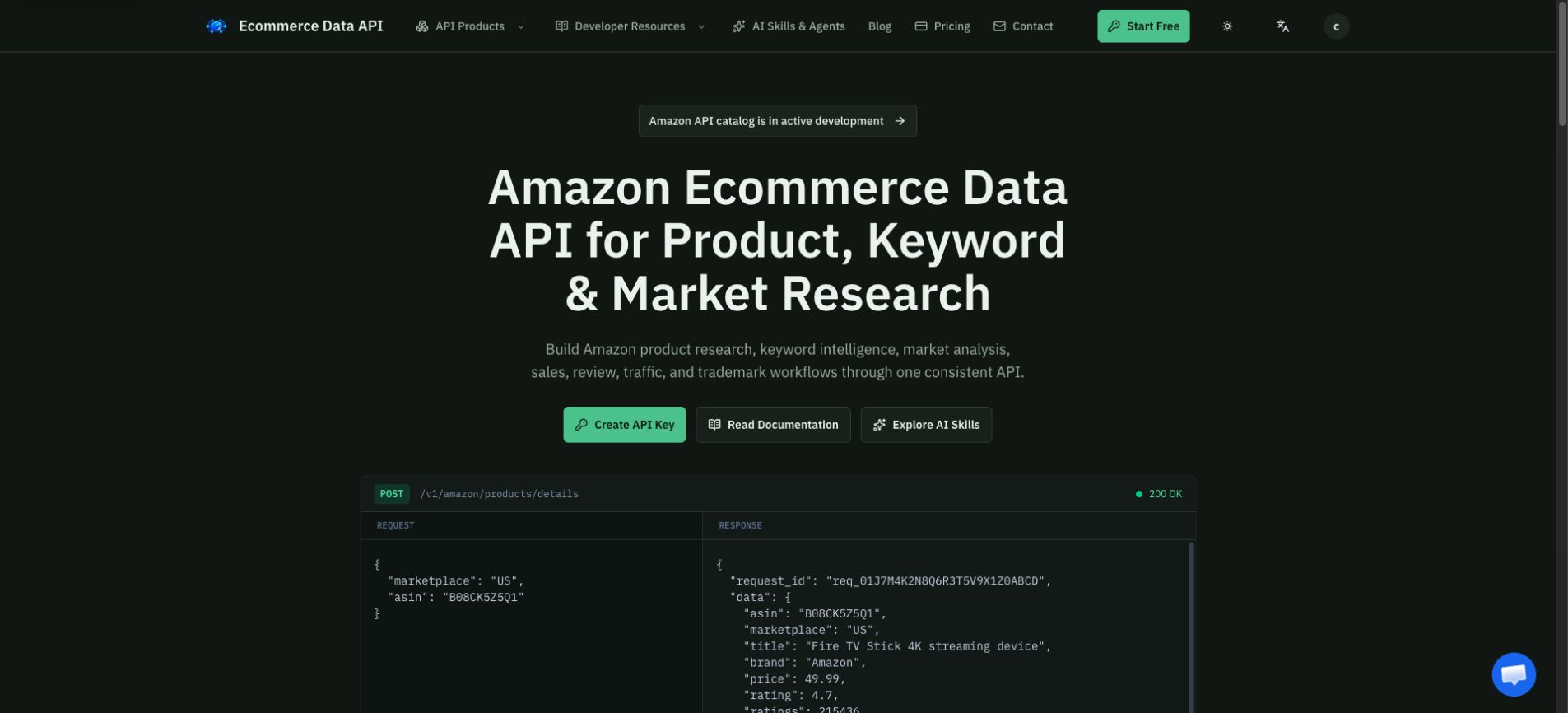
Ecommerce Data API at ecommercedataapi.com is an Amazon data API for sellers, developers and AI agents. One set of REST endpoints, plus a remote MCP server, returns product, keyword, market, sales, review, traffic and trademark data that you can plug into product research tools, dashboards and automated workflows.
A single ASIN detail call, for example, returns the title, brand, price, BSR rank and subcategory, rating and review counts, seller count, fulfillment type, variations, listing quality score and badges such as Amazon’s Choice.
API Groups
- Product data (12 endpoints) — Product search, ASIN details, sales trends, reviews, deals and competitor data.
- Keyword data (11 endpoints) — Keyword research, reverse ASIN lookup, ABA rankings, conversion rates and trends.
- Market analysis (14 endpoints) — Category size, brand and product concentration, price bands, ratings and demand trends.
- Traffic analysis (3 endpoints) — Related products and keyword traffic sources.
- Global trademark data (4 endpoints) — Trademark search, details, status and country coverage.
- Image OCR (1 endpoint) — Read Chinese and Latin text from an image URL, Base64 or upload.
Key Features
- 45 endpoints, one auth — Consistent field names and runnable examples in the docs.
- Remote MCP server — Let AI agents call Amazon research data as tools.
- Usage dashboard — Track credit use, errors and request performance.
- Key management — Create, rotate and revoke API keys at any time.
How It Works
- Create an account and generate an API key.
- Pick the endpoint for your marketplace and use case.
- Send requests from your app, script or AI agent (via MCP).
- Monitor usage and quota in the dashboard.
Documentation: ecommercedataapi.com/docs
Use Cases
- Product selection and niche research for Amazon sellers
- Keyword and search trend tracking for Q4 and seasonal planning
- Competitor monitoring in internal dashboards
- AI agents that answer Amazon market questions with live data
Ecommerce Data API suits sellers and developers who want Amazon research data in code rather than in a browser extension.